
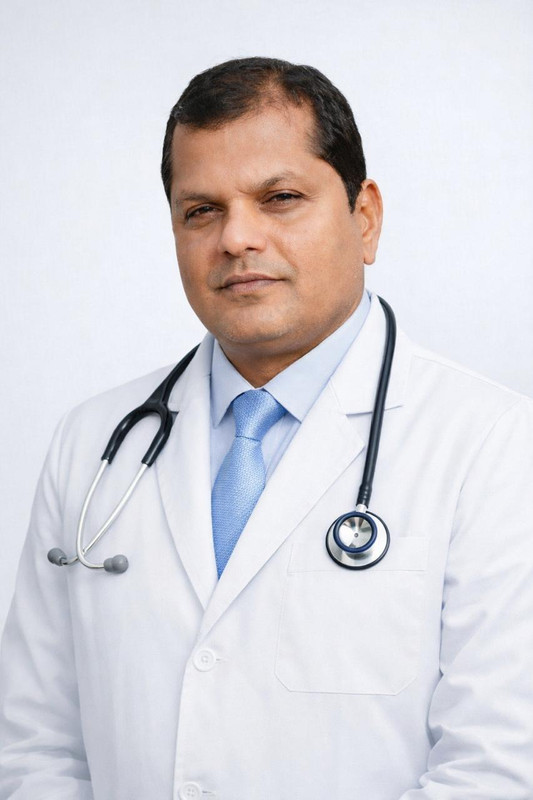
Dr. Jitendra Prasad Yadav
Neurology, Headache Medicine & Sleep Medicine
About
Dr. Jitendra Prasad Yadav is a distinguished Senior Consultant Physician and Neurologist with more than 15 years of clinical practice, including service at National Trauma Center (NAMS). He is the Founder and Medical Director of Kathmandu Neurology Clinic & Cognitive Center and Nepal Sleep Clinic & Headache Center, Dillibazar.
Qualifications
- MBBS (Tribhuvan University)
- MD Internal Medicine (Tribhuvan University)
- FICN (Fellow of the Indian College of Neurology)
- FCNV (Fellow in Clinical Neurophysiology and Neurovascular Diseases)
- FIHM / Fellowship in Headache Medicine (World Headache Society)
- NMC Registration: 8029
- Founder & Medical Director — Kathmandu Neurology Clinic & Cognitive Center
Areas of Expertise
Services
Location & Hours
Kathmandu Neurology Clinic & Cognitive Center
117 Lal Durbar Marg (Opposite Yak & Yeti Hotel), Kathmandu
Everyday: 9:00 AM – 7:00 PM
Languages: Nepali, English, Hindi
Consultation Cost & What the Fee Covers
The consultation fee with Dr. Jitendra Prasad Yadav is NPR 800 (~$6 USD at typical exchange rates). That fee covers the full consultation, the examination, a written treatment plan, and the stamped English medical report valid for insurance claims — plus a 7-day WhatsApp follow-up window.
What the fee does not include: laboratory tests, imaging, medications, and consumables — each is itemized separately and quoted before it is performed, so the receipt never carries a surprise line item. Testing at Kathmandu Neurology Clinic & Cognitive Center is arranged through the network and quoted before the order is placed.
- Self-pay vs. insurance: paying out-of-pocket keeps the visit simple — the stamped documentation is still provided in case you claim reimbursement later.
- Direct billing (GOP): with insurer pre-authorization, covered services can bill directly to the insurer — call the assistance line early for faster approval.
- Value: a specialist consult at NPR 800 runs a fraction of the equivalent visit in the US/UK — with the same documentation standard insurers expect.
Paying in your currency: the fee is charged in NPR and settles at your card's exchange rate — roughly ~$6 USD. Cash, Visa/Mastercard/Amex, eSewa, and Fonepay are all accepted, and the receipt itemizes NPR and USD so reimbursement claims carry no exchange-rate argument.
The cost of waiting: the visit that is skipped to save NPR 800 is the visit that turns a treatable early problem into the imaging, admission, or evacuation bill that dwarfs it — early review is almost always the cheapest version of the same problem.
What a Consultation With Dr. Looks Like
- History first. The visit opens with your timeline — when symptoms started, what changed, what you have already tried, and what you are worried it might be. Honest answers move the visit faster than guarded ones.
- Targeted examination. Only what the problem needs — no ritual exam, no padding. The exam is calibrated to the differential, not the clock.
- Testing when indicated. Testing arranged through the clinic network with results routed back for interpretation.
- A written plan. You leave with a diagnosis or a firm rule-out, a treatment plan with generic drug names, and a stamped English medical report valid for insurance claims and home-country follow-up.
How to Prepare for Your Visit
- Bring your passport (or a clear photo of it) — needed for the medical report and insurance documentation.
- Bring your medication list and any relevant old reports — photos of labels and documents count.
- Have your insurer's 24/7 assistance number handy if you expect to claim — GOP authorization is faster when the line is called early.
- Know your travel dates — departure and trek plans change what gets prioritized in the visit.
- Write down the timeline in your notes app if it is complicated — a messy-but-honest history beats a forgotten detail.
Follow-Up and Referrals
- WhatsApp check-in: a 7-day follow-up window is included — message the clinic line with changes or questions instead of rebooking for something answerable remotely.
- Specialist referral: if the problem needs a specialist or hospital-level care, Dr. writes the referral and your records transfer with it — the receiving physician reads the findings rather than starting over.
- Continuity after Nepal: the stamped ICD-10 report and generic-name prescriptions are designed so your home doctor can pick up exactly where the Kathmandu visit left off.
- Recurrence: if the same problem returns after an apparent recovery, come back — a repeat episode is new clinical information, not a failed visit.
Part of Kathmandu Neurology Clinic & Cognitive Center — see our full clinic network.
