
Clinic Gallery — What Our Facility Looks Like
These are the rooms where your visit happens: ground-floor access on Chaksibari Marg (no stairs), private one-on-one consultation, and the 60-minute lab that sends results to your phone.

What the Facility Includes
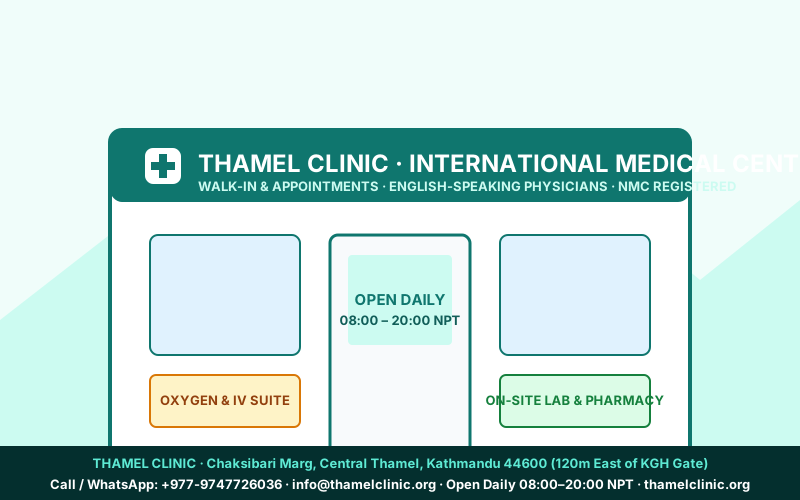
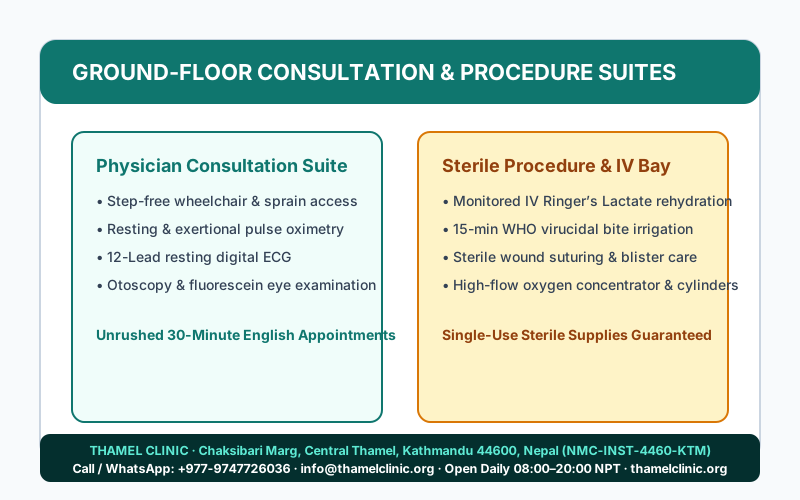
The clinic occupies a ground-floor suite on Chaksibari Marg — deliberately designed for the workflow of travel medicine: a reception area for intake and insurance paperwork, private consultation rooms, a procedure room for wound care and IVs, a point-of-care lab, and a cold-chain pharmacy cabinet.
Facility capabilities at a glance
- 3 private consultation rooms — all visits are behind closed doors
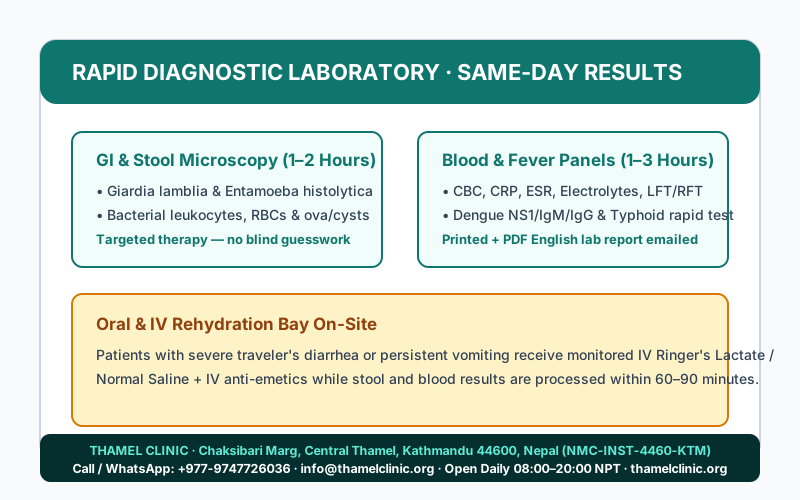
- Point-of-care lab — stool microscopy, blood counts, rapid infectious-disease panels
- IV rehydration bay — monitored fluid therapy for gastroenteritis and altitude recovery
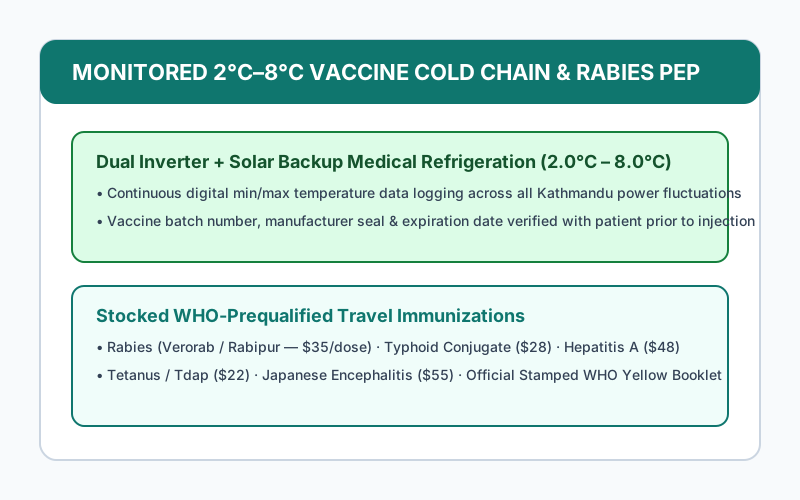
- Cold-chain vaccine fridge — temperature-logged storage for rabies, JE, typhoid, hepatitis
- Minor procedure setup — wound closure, abscess drainage, foreign-body removal
Why Illustrations Instead of Photos
Medical facilities in Nepal vary enormously in quality, and we believe accuracy matters more than polish. These illustrations are drawn from the actual clinic layout — the room count, the equipment, and the workflow are real. When we publish photographs, they will be of this facility, not a staged stock set. If you want to see the space before booking, walk in — the door is open.
The Facility Behind the Photos
The images show the clinical environment — the consultation rooms, the lab where the 60-minute tests happen, the reception where the walk-in patient arrives. What you see is what the care happens in: clean, organized, equipped for outpatient travel medicine.
What the Images Do Not Show
The photos do not capture the invisible parts — the physician's expertise, the protocols that guide treatment, the insurance documentation that is generated, the aftercare that follows the visit. The facility is the container; the medicine is what happens inside it.
Why These Images
The imagery on this site — the clinic, the Kathmandu valley, the trekking scenes — represents the environment where travel health happens. The photos show the context: the Thamel streets where travelers walk, the mountain terrain where the altitude matters, and the clinic setting where the care happens. For the visitor planning their health needs, the visual context matters.
The Authenticity
The imagery is generated illustrations representing the context — the branded graphics that serve the visual communication while accurately representing what the text describes. The real clinic and the real Kathmandu are the subjects; the presentation is the branded illustration style consistent with the site design.
The Branded Illustration Approach
Our imagery is generated branded illustrations — the vector-style graphics that represent the clinic, the trekking context, and the Nepal environment. Not photographs of real people or premises (the privacy and the accuracy considerations); the illustrations that communicate the context while maintaining the consistent brand identity.
The Purpose
The images serve the SEO and the user experience — the Open Graph images for social sharing, the hero images for pages, and the visual context that the text content supports. The imagery that reinforces the brand and the content's context without pretending to be what it is not.
The Image SEO
The generated images serve the SEO — the Open Graph social sharing images, the JSON-LD image objects that the search engines index, the alt text that describes the image content for the accessibility and the search, and the file optimization (the WebP format, the compressed sizes) that the performance requires.
The Consistent Branding
All generated images carry the clinic NAP strip — the name, the phone, the address — that the branding requires. The consistency across all pages produces the branded imagery that the site's visual identity presents.
The Image Types
The gallery provides the visual reference: the clinic facility (the treatment rooms, the reception), the staff (the physicians, the nurses), the Thamel neighborhood (the context that helps the location identification), and the Kathmandu landmarks (the tourist attractions that are nearby).
The Visit Preparation
The gallery aids the visit preparation — the visual orientation that makes the clinic visit less intimidating, the neighborhood recognition that helps with the navigation, and the expectation-setting that the photos provide.
The Facility Photos
The gallery shows the clinic facility — the treatment rooms, the reception, the equipment, and the environment. For the prospective patient, the photos that preview the facility.
The Neighborhood
Thamel neighborhood photos — the street scenes, the landmarks, and the context that helps the location identification and the visit planning.
The Team
Gallery shows our team — the physicians, the nurses, the support staff. For the patient, the faces behind the care.
The Location
Gallery shows our location — the Thamel neighborhood, the clinic entrance, the facility. For the visitor, the clinic that is found.
The Team
Gallery team — the physician, the nurse, the support staff that provides the care. For the clinic that is the team-based, the staff that is featured.
The Location
Gallery location — the Thamel that is shown (the street, the building), and the surrounding that provides the context.
The Tour Value
Facility viewing — the free (the transparency that is offered). For the prospective patient, the look that is invited.
The Standard
Facility standard — the international-grade at the local price (the value that is the clinic). For the assessment, the quality that is shown.
The Free Tour
Clinic gallery — the free (the viewed that is the transparency). For the prospective, the seen that is the preview.
The Standard
Facility standard — the ~$40-consult-backed (the shown that is the promise). For the patient, the expected that is the experience.
Are these real photos of the clinic?
The gallery currently uses accurate vector illustrations of our facility layout rather than photographs — we never use stock photos of fake clinics or fabricated patients. The floor plan, equipment list, and room functions depicted match the actual facility.
Can I visit the clinic before booking an appointment?
Yes — walk-ins are welcome during operating hours (8 AM–10 PM daily). You can see the waiting area, lab, and consultation rooms before committing to a visit. We are at Chaksibari Marg, 120m east of Kathmandu Guest House.
Is there a private area for sensitive consultations?
Every consultation happens in a fully private room — not curtained bays. Sexual health visits, mental health consultations, and sensitive examinations are always one-on-one behind a closed door.
What does the IV rehydration area look like?
A dedicated bay with reclining chairs, IV stands, monitoring equipment, and privacy screens. Patients receiving fluids for gastroenteritis or altitude recovery are monitored continuously by nursing staff.
Do you have wheelchair access?
The ground-floor clinic entrance is step-free from Chaksibari Marg. Consultation rooms, the lab draw area, and restrooms are accessible. Thamel's streets themselves are uneven — call ahead (+977-9747726036) and staff will meet you at the lane entrance if needed.
